
“Cloning Cities: The Extinction of the Traditional Bar and the Rise of Franchise Architecture”
Just a few months ago, we read a newspaper article with a headline that caught our attention: “Goodbye to the zurito in Bilbao? It seems they’re trying to put an end to our traditional ‘poteo.’” It made us wonder what is really happening in our local bars for something as deeply rooted and characteristic as the zurito to be slowly dying out. The answer, or at least a large part of it, lies not only in what we consume but in the environment where it is served. The loss of these customs is closely linked to the architecture and design of these spaces: the physical transformation of our bars is changing the way we interact with them.
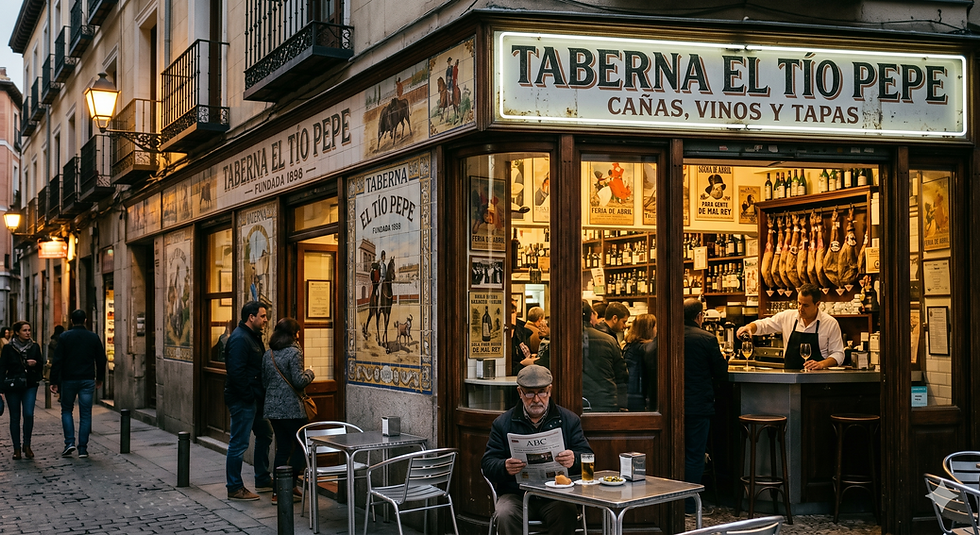
When we talk about the impact of tourism and contemporary architecture on our streets, the first thing that comes to mind is, inevitably, the housing crisis. And that is understandable. Housing is a major issue of crucial importance, and we promise to give it the thorough analysis it deserves in a future publication. But today we want to look down from the balconies and focus on what is happening at street level, in the ground-floor spaces. Today, we are going to talk about bars.
Our cities are undergoing a silent but relentless architectural and social transformation. We are witnessing the slow disappearance of the traditional, old-fashioned bar.
“From the local tavern with its own identity to the global ‘copy and paste’ approach”
For decades, the bar in Spain was more than just a place to drink: it was an extension of the living room, a social anchor. It didn’t matter whether we were talking about a tiled tavern in Madrid or a traditional txoko or tavern in the heart of the Basque Country. Each place breathed the identity of its neighbourhood, its climate and its people.
However, the current urban landscape dictates a different rule. Today, you can sip a specialty coffee in Madrid, sitting on an industrial-style metal chair under a filament bulb, and feel as if you were in London, Berlin or any other city in the world. Mass tourism and commercial gentrification have led to a brutal homogenisation.
We have gone from having the same bars across Madrid to having the same ones as in the rest of Spain. And, to make things even worse, we are not even setting trends: we are simply copying what has already worked elsewhere, following in other people’s footsteps. We are importing cloned aesthetics (exposed brick walls, neon signs with motivational phrases, menus of avocado toast and brioche) that completely erase the traditional architecture of our commercial spaces.
The data behind the extinction
This perception of loss of identity is not mere nostalgia: the data supports it. If we look at the figures, the picture is clear.
According to the Spanish Hospitality Yearbook, published by Hostelería de España (the Spanish Hospitality Association), Spain is a leading country in the sector, contributing over 4.8% of national GDP and employing nearly 1.8 million people during peak season. We have an astounding average of 431 bars per 100,000 inhabitants (approximately five times the number of schools, according to cross-referenced data from the National Statistics Institute). In total, the sector comprises more than 318,000 establishments.
But here is the catch: although overall hospitality revenue is growing, the Yearbook has been warning of a structural trend for years. The number of traditional bars (listed under “Drinking Establishments”) has been gradually declining, while restaurant chains, franchises and niche venues aimed at tourists are on the rise. Independent, local businesses are being pushed out to make way for the investment model.
The impact on the citizen
This “architecture of tourism” displaces residents in two ways. First, physically: the bar ceases to be a neighbourhood meeting place and becomes a thoroughfare for visitors, with prices out of reach for the average citizen. Second, emotionally: the neighbourhood loses its visual and cultural anchor.
The architecture of our bars reflects the city model we are building: a globalised showcase, beautiful in an Instagram photo, but increasingly empty of the essence that made it attractive in the first place.
Our Vision: Architecture for citizens first, and algorithms second.
To conclude this reflection, we want to make our position clear: the issue is not about rejecting the modernization of spaces. That would be absurd and counterproductive. The architectural and strategic challenge lies in modernizing them while preserving their character. Today, more than ever, we need to design spaces conceived for citizens—spaces that reflect who we are as a society and, above all, who we were yesterday. For tourism to be truly sustainable, it is essential that cities are conceived and designed, first and foremost, from the perspective of the citizens who inhabit and experience them on a daily basis. And to achieve this, the interior of a bar can never be a copy-paste of the bar next door, of the one in the next town over, let alone one in a city 10,000 kilometers away. True innovation lies in authenticity, not in replication.
